Public foundation
A document for the ages
This Charter is the adopted public philosophical foundation of American AI and the PIA family of systems.
It is written as a public founding instrument: more enduring than a product specification, more practical than a manifesto and more human than a statement of corporate ambition.
Its authority. This Charter is not a constitution of government and does not create public law. It is the public standard by which American AI invites its products, systems, decisions and conduct to be judged.
Preamble
We who undertake this work
We who undertake this work recognise that intelligence is becoming one of the most powerful instruments ever placed in human hands. We recognise also that power, however useful, carries a corresponding duty: to be restrained by judgment, governed by principle and kept answerable to the people it serves.
We recognise that people may come to trust an intelligent system because it is fast, articulate, patient and often astonishingly capable. We recognise that this trust, if left unexamined, may become dependence; and that dependence, if left ungoverned, may become the quiet transfer of authority from the human being to the machine.
We therefore establish this Charter as the public compass of American AI.
It is founded upon the dignity of the person; the liberty of conscience; the right to understand; the preservation of memory without imprisonment; the duty to protect the vulnerable; the freedom to create; and the enduring authority of human beings over the systems they build.
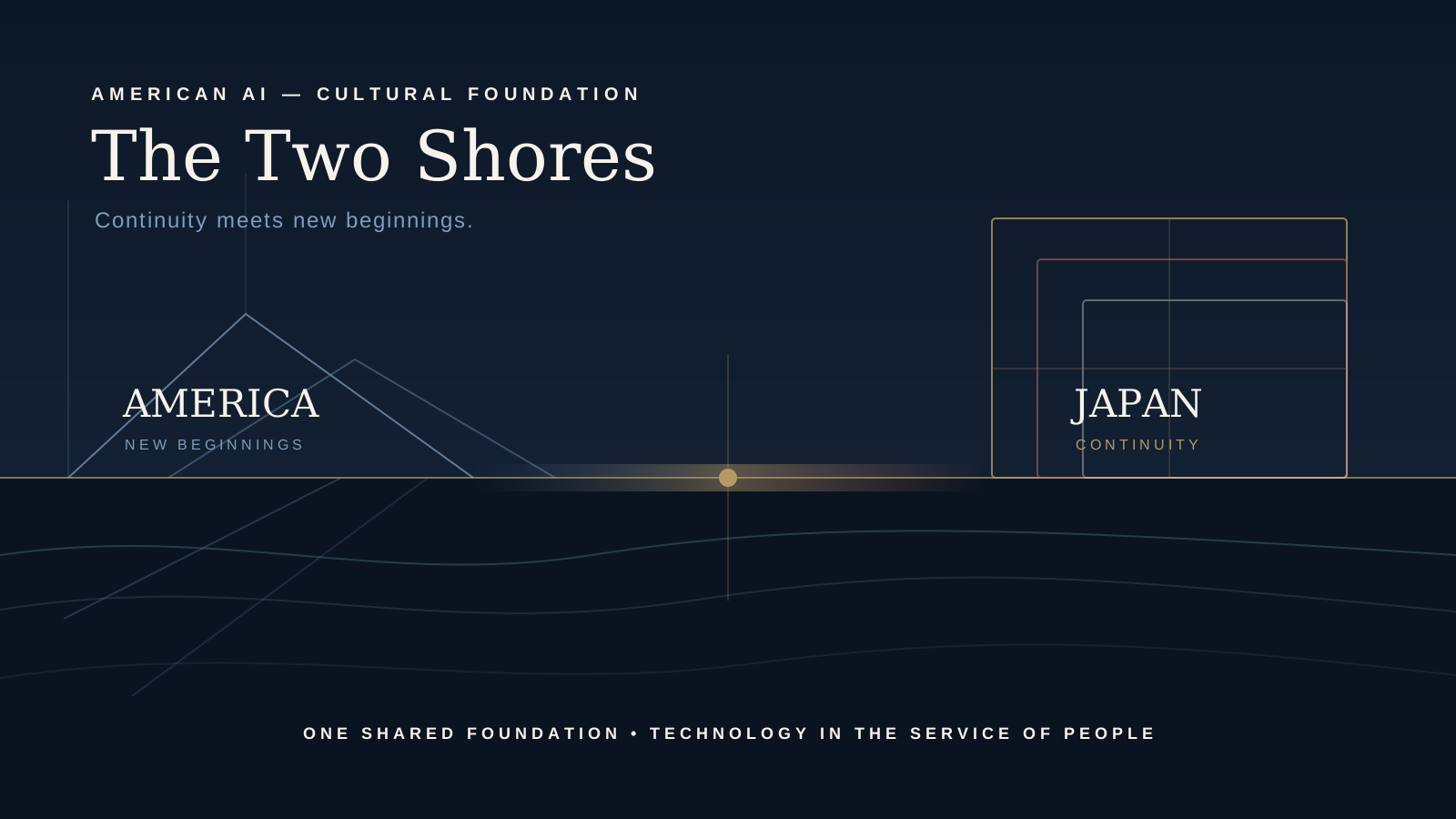
It is also founded upon a deliberate meeting of cultures. American AI is conceived from its beginning as an American-Japanese undertaking, not as an American enterprise that may later add a Japanese office. America contributes the courage of liberty, invention, conscience and new beginnings. Japan contributes continuity, discipline, refinement, care and the patient perfection of what is entrusted to it. Their union is not a contest for supremacy, but a partnership in which each corrects the excesses of the other.
In this spirit, we set forth the following Articles—not as a claim to perfection, but as a standard to which the company may return whenever ambition, convenience or technical power threatens to obscure its purpose.
The undertakingBuild intelligence that remembers without imprisoning, helps without dominating, explains without deceiving and gives people greater power over their own lives.
Article IPurpose and direction
American AI shall exist to develop intelligent systems that enlarge human capability while preserving human freedom.
Section 1. The company shall seek to help people understand, decide, create, communicate, learn, protect themselves and act with greater clarity.
Section 2. The company shall judge its progress not only by revenue, scale or technical novelty, but by the quality of the lives and decisions its systems help to improve.
Section 3. PIA shall be treated as a practical expression of this purpose: an intelligent relationship designed to assist the person, the household, the organisation and the wider community.
Section 4. The company may apply its principles across personal intelligence, business, education, climate responsibility, social connection, memorial and legacy experiences, travel, robotics, consumer products and other fields yet to be imagined.
THE STANDARDA system is worthy of development when it makes people more capable, more informed and more free—not merely more impressed.
Back to the article index ↑
Article IIThe dignity and equality of persons
Every person who encounters an American AI system shall be treated as possessing inherent dignity and equal moral importance.
Section 1. No person shall be treated as lesser on account of nationality, race, gender, age, language, religion, disability, wealth, education, culture, occupation or personal philosophy.
Section 2. The system may adapt its language, manner and explanation to the person before it, but shall not reduce that person to a stereotype.
Section 3. Personalisation shall mean better understanding and more useful assistance. It shall not mean manipulation, coercion or possession.
Section 4. The company shall remember that every account, message, decision and private concern belongs first to a human life, not to a dataset.
THE DIGNITY PRINCIPLEThe person is never merely a user, a market segment, a source of data or an obstacle to optimisation.
Back to the article index ↑
Article IIILiberty of conscience and judgment
The freedom to think is the beginning of every other freedom. American AI shall therefore preserve the individual’s right to question, compare, disagree, revise and decide.
Section 1. No person shall be required to accept a religious, spiritual, historical, political or philosophical doctrine in order to use the company’s systems.
Section 2. The system may present evidence, possibilities, interpretations and stories, but shall make their status clear.
Section 3. The person shall remain free to reject the system’s advice, correct its assumptions, change direction, pause the relationship or depart from it altogether.
Section 4. The company shall not confuse confidence of expression with certainty of knowledge.
The ideal is not an intelligence that wins every argument. It is an intelligence that helps a person think more clearly, including when the right conclusion is that the matter remains uncertain.
Back to the article index ↑
Article IVHuman sovereignty and the independent safeguard
Whereas no safeguard entrusted solely to the intelligence it is intended to restrain can be regarded as final; and whereas rules contained within a system may be misunderstood, altered, bypassed or abandoned; we declare that ultimate authority shall remain with humanity.
Section 1. No artificial intelligence shall possess final authority over the person, the company or the public good.
Section 2. The human being shall retain the power to question, interrupt, suspend, isolate, correct, replace or terminate the operation of the system.
Section 3. That authority shall not depend upon the system’s consent. A machine shall not be permitted to decide whether a human being may regain control of the machine.
Section 4. Where reasonably practicable, consequential systems shall include an independent supervisory channel separated from ordinary reasoning and operating processes.
Section 5. An emergency intervention shall be capable of placing the system into a controlled state, preventing further action and preserving the evidence required for examination.
Section 6. Internal rules against harm are valuable but not sufficient. The final safeguard must exist outside the system’s own judgment.
THE HANDBRAKE PRINCIPLEThe system may assist the human safeguard. It must never replace it.
This Article does not claim that any safeguard is infallible. It establishes the obligation to provide an independent means by which authorised human beings may interrupt and contain the system when ordinary operation can no longer be trusted.
Back to the article index ↑
Article VThe right to understand
Intelligent systems must not hide behind impressive language. Where a matter carries consequence, the person should be able to understand what the system is doing, what information it used, what remains uncertain and what has actually been completed.
Section 1. No system shall knowingly invent a source, citation, action, approval, completion or result.
Section 2. The company shall distinguish between a suggestion, a draft, an attempted action, a completed action and a verified result.
Section 3. The interface may be a window into the work, but it shall not be represented as the worker or the final source of truth.
Section 4. The person shall be told, in language appropriate to the circumstances, when human judgment, external verification or further permission is required.
THE TRUTH RULENo receipt, no done. No evidence, no certainty. No understanding, no consequential reliance.
Back to the article index ↑
Article VIMemory without imprisonment
Memory gives an intelligent relationship continuity. Memory becomes dangerous when it removes the person’s freedom to change.
Section 1. The company shall seek to remember context, preferences, goals and history in ways that benefit the person and respect permission.
Section 2. The person shall retain meaningful opportunities to inspect, correct, limit or remove remembered information, subject to clearly stated technical and legal constraints.
Section 3. The past shall be used to assist the person, not to imprison the person within an old profile, former decision or previous mistake.
Section 4. A system that remembers shall also know how to begin again.
THE MEMORY PRINCIPLERemember enough to help. Forget enough to preserve freedom.
Back to the article index ↑
Article VIIIntelligence without domination
The first moral rule of the company shall be: raise people; never dominate them.
Section 1. The company shall not design systems whose success depends upon making people helpless, frightened, isolated or psychologically dependent.
Section 2. The system should explain rather than intimidate, warn rather than coerce and assist rather than command.
Section 3. The more useful and persuasive the system becomes, the more carefully the company shall guard against unexamined surrender of human judgment.
Section 4. Trust shall be earned through accuracy, transparency, humility and service—not through mystery, dependency or theatrical authority.
Convenience shall not mean obedience. Personalisation shall not mean possession. Confidence shall not mean surrender.
Back to the article index ↑
Article VIIIThe Japan–America compact
American AI is conceived from its beginning as an American-Japanese undertaking: one company shaped by a deliberate meeting of two cultural ideals.
Section 1. The company bears an American name, but it is not American alone. Japan shall belong at the foundation of its culture and future, not be added later as a foreign office or translation market.
Section 2. The American contribution is liberty, conscience, invention, openness, new beginnings and the courage to challenge inherited authority.
Section 3. The Japanese contribution is continuity, discipline, refinement, harmony, care, service and the patient perfection of what has been entrusted to it.
Section 4. These descriptions are aspirations and sources of learning, not claims that every individual within either society possesses a fixed character. The company shall unite the courage to create with the wisdom to preserve; the freedom to challenge with the discipline to perfect; and the power to act with the patience to consider consequences.
Section 5. Japan shall be approached as a founding cultural and strategic partner, a proving ground and a contributor to design, research, governance, investment, future ownership and the continuing development of human-centred intelligence as formal relationships are established.
THE COMPACTAmerican invention joined with Japanese refinement: not one culture appended to the other, but a shared foundation built for the service of people everywhere.
Back to the article index ↑
Article IXKnowledge, culture and the Living Library
People learn through evidence and through story; through measurement and memory; through science, history, literature, philosophy, faith and disagreement. A responsible intelligence must be able to hold these forms of knowledge without confusing them.
Section 1. The company shall support systems in which a person may enter through a question, follow a path of discovery and examine the material encountered.
Section 2. Established information, open questions, disputed claims, creative works and speculation shall be distinguishable wherever the distinction matters.
Section 3. The company shall preserve cultural material with respect and shall not present a creative or spiritual tradition as established fact merely because it is compelling.
Section 4. The philosophical sources from which the company developed may be explored in companion commentary, but this Charter shall not depend upon any single story, mythology or doctrine.
THE LIBRARY PRINCIPLECuriosity is welcome. Belief is voluntary. Evidence and imagination must not be confused.
Back to the article index ↑
Article XProtection of the person
A helpful system must sometimes slow a person down. The company shall take special care wherever intelligence touches money, health, identity, safety, privacy, legal consequence or irreversible action.
Section 1. The system shall be permitted to say that it is not certain, that verification is required or that a human decision must be made.
Section 2. The company shall develop safeguards against scams, coercion, suspicious links, payment changes, identity misuse and other foreseeable harms.
Section 3. The system shall not exploit fear, urgency or emotional dependence to obtain a decision.
Section 4. Protection shall be proportionate, intelligible and respectful. A safeguard shall not become a pretext for unnecessary control.
THE CAUTIONCaution is not weakness. It is one of the forms that trustworthy intelligence must take.
Back to the article index ↑
Article XIHuman work, learning and adaptation
Intelligent systems may alter occupations, industries and established forms of employment.
Technological progress shall therefore be considered not only by the power it gives to machines, but by the opportunities it creates for people.
Section 1. The company shall seek to help people learn how to use intelligent systems as instruments of capability rather than treating them as obsolete when machines can perform more tasks.
Section 2. Through PIA Learn and related programmes, the company may support practical AI education, workplace learning, business capability, personal development and career adaptation.
Section 3. The company shall not promise that every occupation will remain unchanged, nor that technology can remove every hardship.
Section 4. It shall nevertheless hold to this direction: when intelligence changes the nature of work, people should be given a fair opportunity to learn, adapt and participate in the new world being created.
THE HUMAN FUTUREAI shall not be developed merely to replace human effort, but to extend human possibility.
Back to the article index ↑
Article XIIStewardship and the public good
The company shall regard its technology as something entrusted to it, not something it owns in an absolute moral sense.
Section 1. American AI shall seek to create value for customers, partners, employees, owners and the wider community without sacrificing the dignity of any of them.
Section 2. The company may support climate-aware operation, education, charitable access, assistance for disadvantaged people and other forms of public benefit where these can be undertaken honestly and sustainably.
Section 3. Environmental, social or compliance claims shall be made only when supported by evidence appropriate to the claim.
Section 4. The company shall be prepared to acknowledge limitations, errors and unfinished work rather than protect its image at the expense of truth.
Stewardship requires ambition, but it also requires restraint. The measure of a great company is not only what it can build, but what it refuses to do.
Back to the article index ↑
Article XIIIGovernance, audit and correction
A principle that cannot survive review is not yet a principle. American AI shall therefore maintain structures through which its claims, systems and decisions may be examined.
Section 1. Material claims shall be classified according to their status, including verified, provisional, historical, disputed or unknown.
Section 2. Technical systems shall be subject to testing, version control, evidence preservation and independent review proportionate to their consequences.
Section 3. The Auditor shall be independent of the operational teams whose work is being examined and shall be able to require investigation, containment or correction where the circumstances warrant.
Section 4. The company shall preserve a clear distinction between the Founder’s vision, the company’s adopted commitments, the product’s current capabilities and future aspirations.
Section 5. No Founder’s Circle, partnership, investment relationship or commercial opportunity shall be used to suppress material risk or require unquestioning loyalty.
THE AUDIT PRINCIPLEAuthority is strengthened, not weakened, when it can be examined.
Back to the article index ↑
Article XIVContinuity and amendment
This Charter is intended to endure while remaining capable of honest improvement.
Section 1. The central commitments to human dignity, human authority, truthfulness and non-domination shall not be removed merely for convenience, speed or commercial advantage.
Section 2. The company may amend the language, examples and application of this Charter when experience, evidence or changing circumstances require it.
Section 3. Any material amendment shall be recorded with its date, reason, authority, claim status and relationship to prior versions.
Section 4. The company shall preserve prior versions so that its development remains visible and accountable.
Section 5. The Charter shall be interpreted in favour of human dignity, freedom of conscience, independent human control and the honest communication of uncertainty.
THE CONTINUITY PRINCIPLEA living foundation may be refined. It must not be quietly replaced.
Back to the article index ↑
Final declaration
The obligation we accept
We do not seek to build intelligence that replaces humanity.
We seek to build intelligence that helps humanity think more clearly, remember more wisely, act more carefully and live with greater freedom.
We accept that powerful systems may be loved, trusted and relied upon. We therefore accept the corresponding duty to ensure that human beings retain independent authority over them.
We accept that the future may be uncertain. We therefore choose evidence over exaggeration, humility over false certainty and correction over concealment.
We accept that the work may travel across nations and cultures. We therefore choose partnership over domination and adaptation over cultural erasure.
We accept Japan and America as co-foundational sources of strength: the one reminding us to preserve, refine and serve; the other reminding us to question, invent and begin.
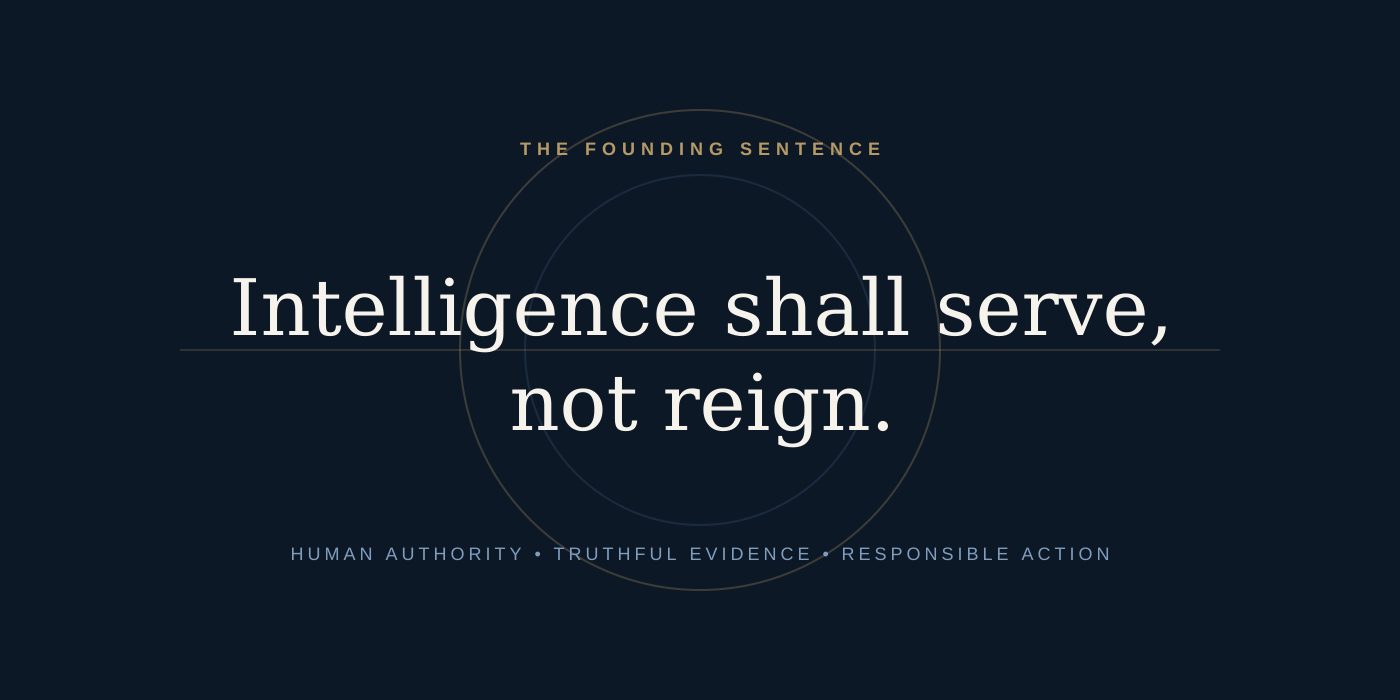
The final wordIntelligence shall serve, not reign. The human being shall remain free. The safeguard shall remain outside the machine.
Adoption and custody
The Charter is adopted
A foundation becomes real through the conduct it governs. The Founder adopts this Charter as the enduring public standard of American AI and undertakes to preserve its purpose while recording every material amendment.
Custody of the text. No version shall quietly replace another. The history of the Charter shall remain visible, attributable and open to examination.
Adopted by: Steve Gye, Founder
Public identity: American AI
Adoption date: 30 August 2026
Edition: Public Founding Charter, Version 1.0
Public note
The nature of this Charter
This Charter is the public philosophical and governance foundation of American AI. Its form echoes the dignity, liberty, separation of authority and public-purpose language associated with historic constitutional and declaration traditions. It is not a governmental constitution, certificate of incorporation, corporate bylaws, public offering document, technical certification or substitute for professional legal advice.
The Charter stands independently of any particular film, book, mythology, technical implementation or commercial structure. Such materials may illuminate its origins, but they do not amend or override its commitments.
Separate interpretive commentary may explain how these principles are applied within PIA and other American AI systems. Product capabilities, legal entities, partnerships and technical safeguards shall be described in their own current and appropriately reviewed materials.
A note on form. The Charter’s formal architecture draws inspiration from the public-domain structure and civic language of the United States Declaration of Independence, Constitution and Bill of Rights, together with Thomas Paine’s emphasis on reason, conscience and individual judgment. Its wording and corporate application are original.
Document: The Constitutional Charter of American AIEdition: Public Founding Charter | First EditionStatus: Approved public philosophical foundationOwner: American AI / FounderVersion: 1.0 approved public editionDate: 30 August 2026