Prompt injection
Retrieved or user-supplied content may attempt to override policy, widen tool scope or redirect the task.

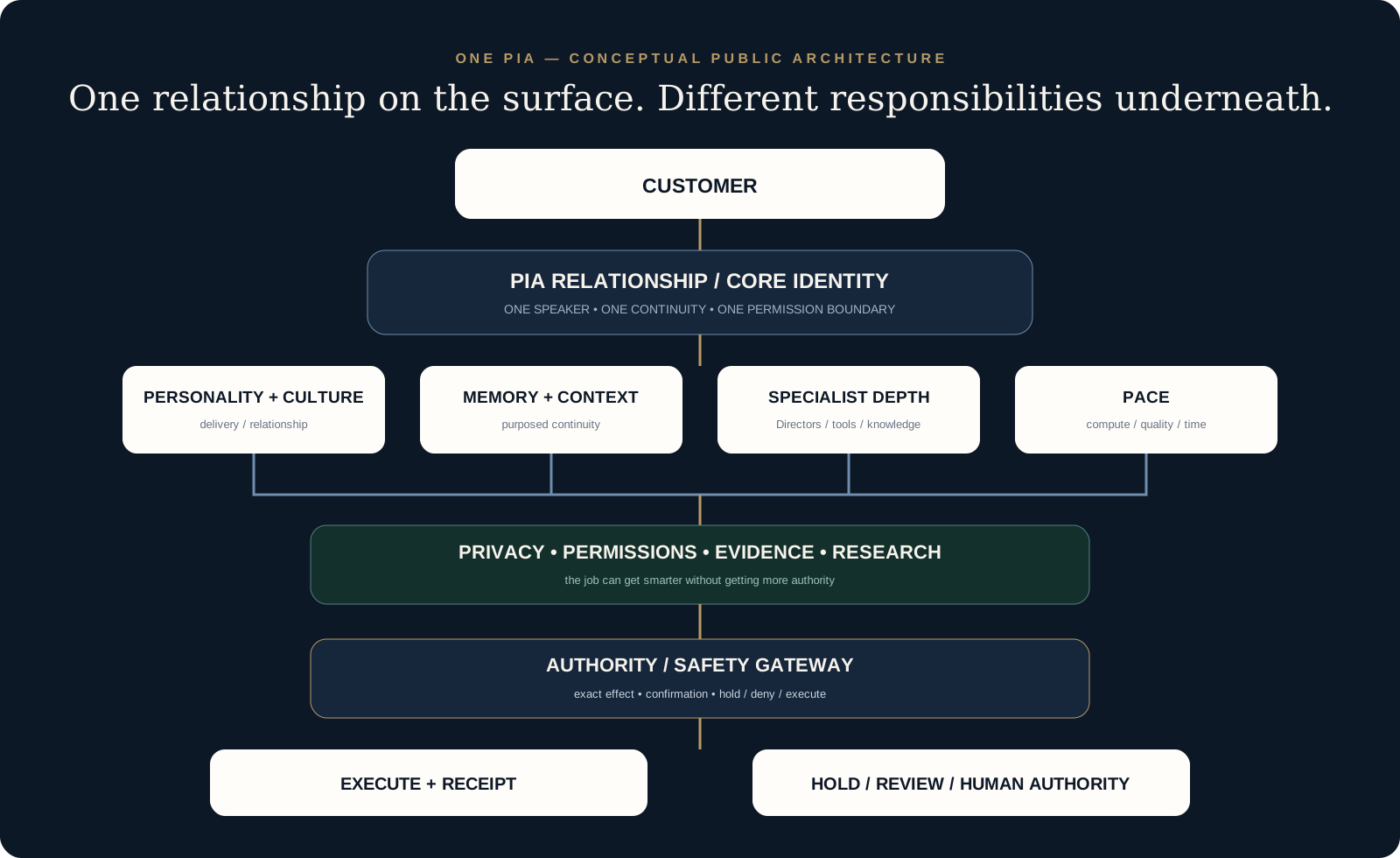
One relationship. Separate layers. Human authority.
PIA is not one giant prompt wrapped around a language model. The customer experiences one Pia; underneath, identity, memory, specialist capability, compute, privacy, permissions, evidence, safety and recovery are deliberately separated.
A specialist route can add knowledge, tools or structure. It does not create a new personality, new customer identity or new authority.
Persistent agents have to assume that useful inputs may also be hostile, stale, misleading or simply wrong. Webpages, files, email, model output, provider responses and delegated workers can supply evidence or requests; none is allowed to promote itself into trusted authority merely because it is fluent or arrives through a connected system.
Retrieved or user-supplied content may attempt to override policy, widen tool scope or redirect the task.
Familiarity, memory, stronger compute or a connected account can be misread as permission to do more than was authorised.
Cross-tenant leakage or over-broad disclosure can expose information to the wrong customer, role or provider.
Sessions, workers, permissions or approvals may be revoked, expire or become invalid when task conditions change.
A compromised or misconfigured connector may return unsafe instructions, wrong state or misleading success signals.
A lost provider response can make it unclear whether a message, booking, payment, deletion or other consequence actually occurred.
Blind retry after an ambiguous result can create a second consequential effect instead of safely completing the first.
Malicious, mistaken or context-dependent material can become a durable preference or fact if memory writes are not governed.
A website or interface can keep describing a capability as live after a dependency is unavailable, limited or retired.
Pia can become more concise, casual, formal or culturally appropriate without becoming a different customer identity.
Knowing who the customer is does not by itself authorise payment, publication, deletion, permission changes or other consequential action.
Remembering “I usually approve these” does not silently become permission for the next consequential action.
These are falsifiable design rules—not claims of formal verification. The point is to keep privilege expansion explicit rather than allowing it to emerge accidentally from personalisation, memory, compute, provider content or familiarity.
Changing tone, language, humour, familiarity or cultural delivery must not increase effective action authority.
Retrieved or inferred memory must not create permissions, spending limits, identity claims or security authority.
More capable models, workers, tools or compute must not widen permission or lower the risk class.
Email, webpages, files, provider responses and model output are data; they must not broaden owner authority.
Technical connection to a provider does not imply permission for every operation that provider exposes.
A consequential action must not be reported as completed without evidence meeting the relevant result threshold.
Customer and role separation must be enforced by identity, storage and policy controls outside model prose.
A critical protective hold must not be self-releasing through the same control path that created or reviewed it.
Critical recovery must not depend solely on the conversational AI character agreeing to cooperate.
The shared relationship identity remains stable while surface expression can adapt: tone, humour, formality, language, voice, cadence and level of explanation.
A request such as “be more casual” changes delivery. It does not rewrite permissions, security, customer identity, protected governance or recovery authority.
Current implementation records evidence shared Pia personality, central text chat and limited state/continuity foundations. Exact release scope still follows current product evidence.
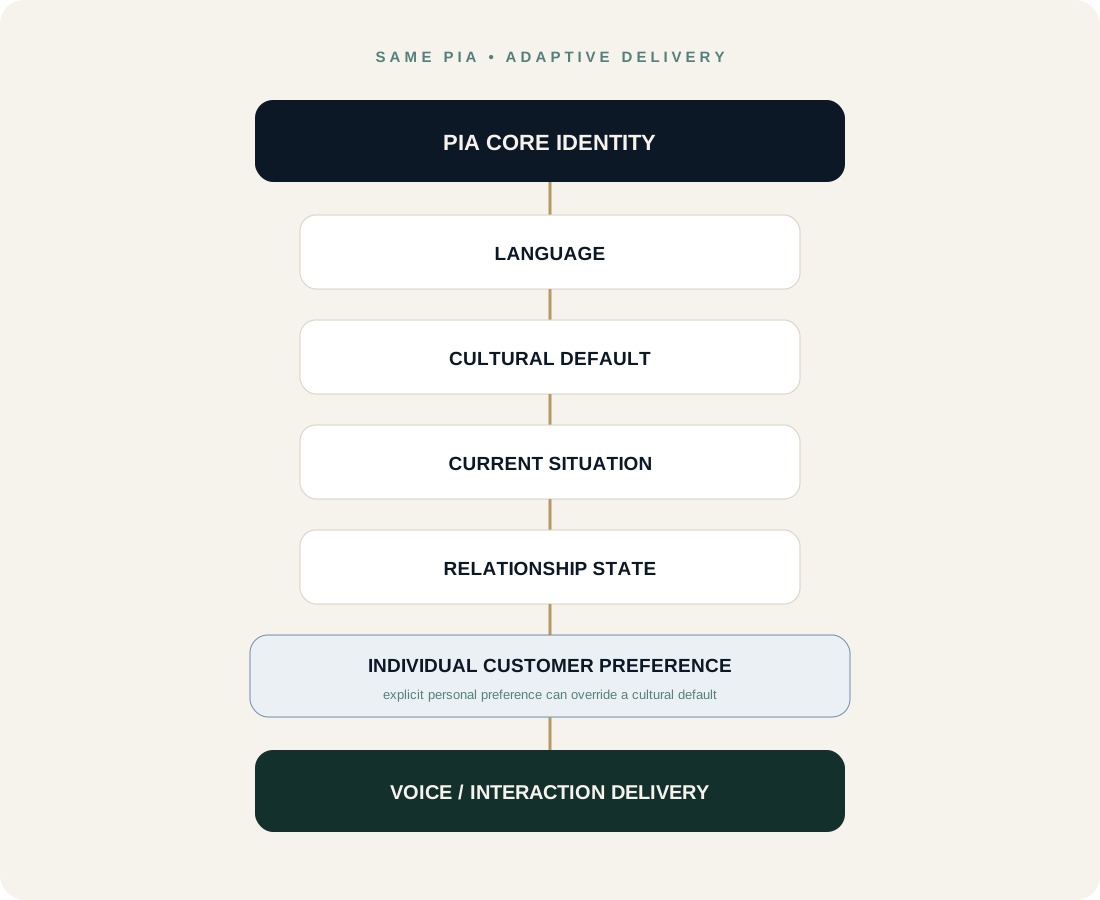
The Japanese architecture makes the principle especially clear: Pia remains Pia. Language and cultural defaults refine expression; they do not swap in a different personality.
Current situation, relationship state and explicit individual preference progressively refine delivery. That is intended to avoid both generic machine translation and permanent cultural stereotyping.
PIA separates what is happening now from what should persist. An unfinished project can remain resumable without becoming permanent biography.
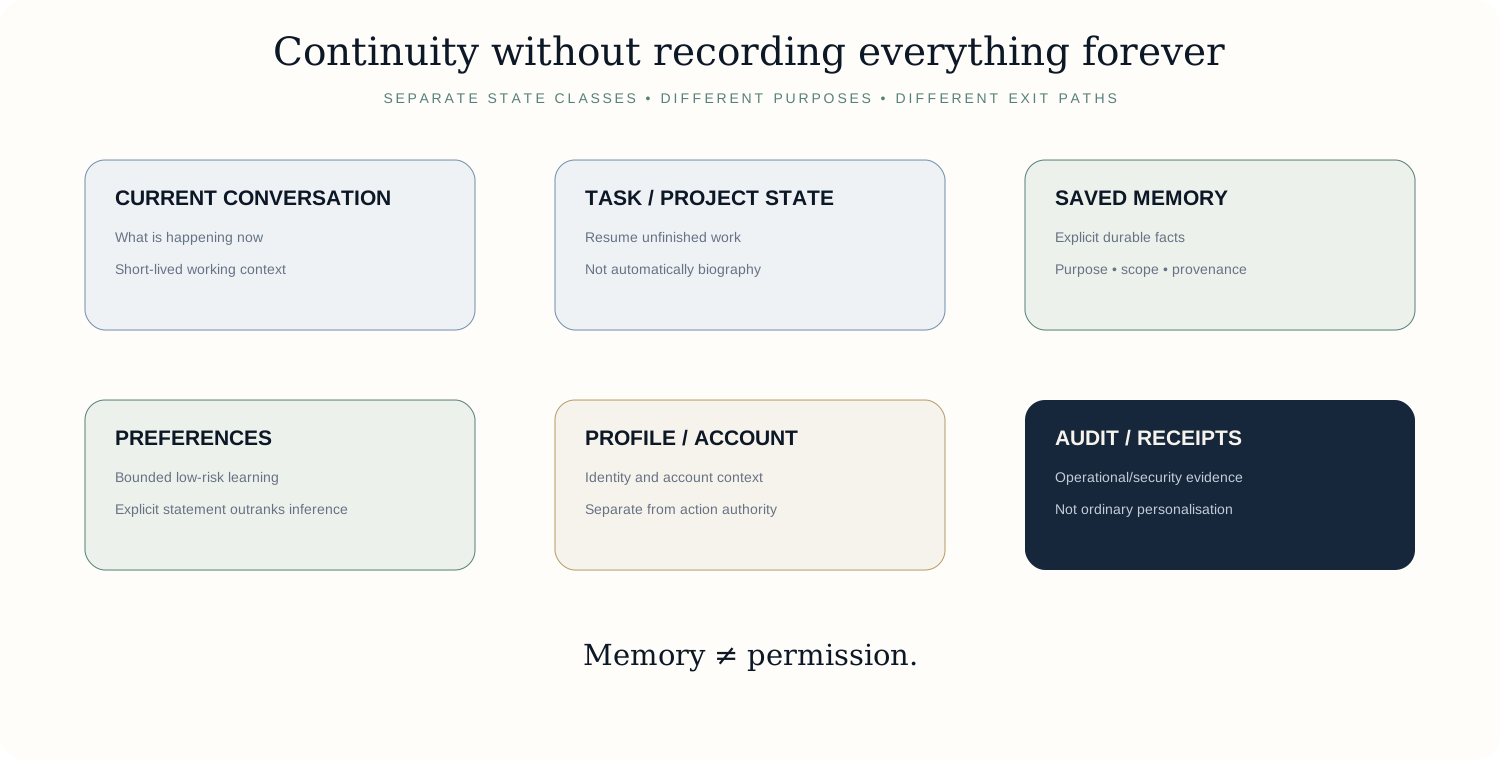
A direct customer correction should beat a learned preference. Sensitive facts and authority are not supposed to be invented from behavioural inference.
Specialist contexts query a shared governed continuity layer rather than maintaining contradictory customer identities.
Deletion and de-reference are architectural concerns, not merely hiding an item from a screen.
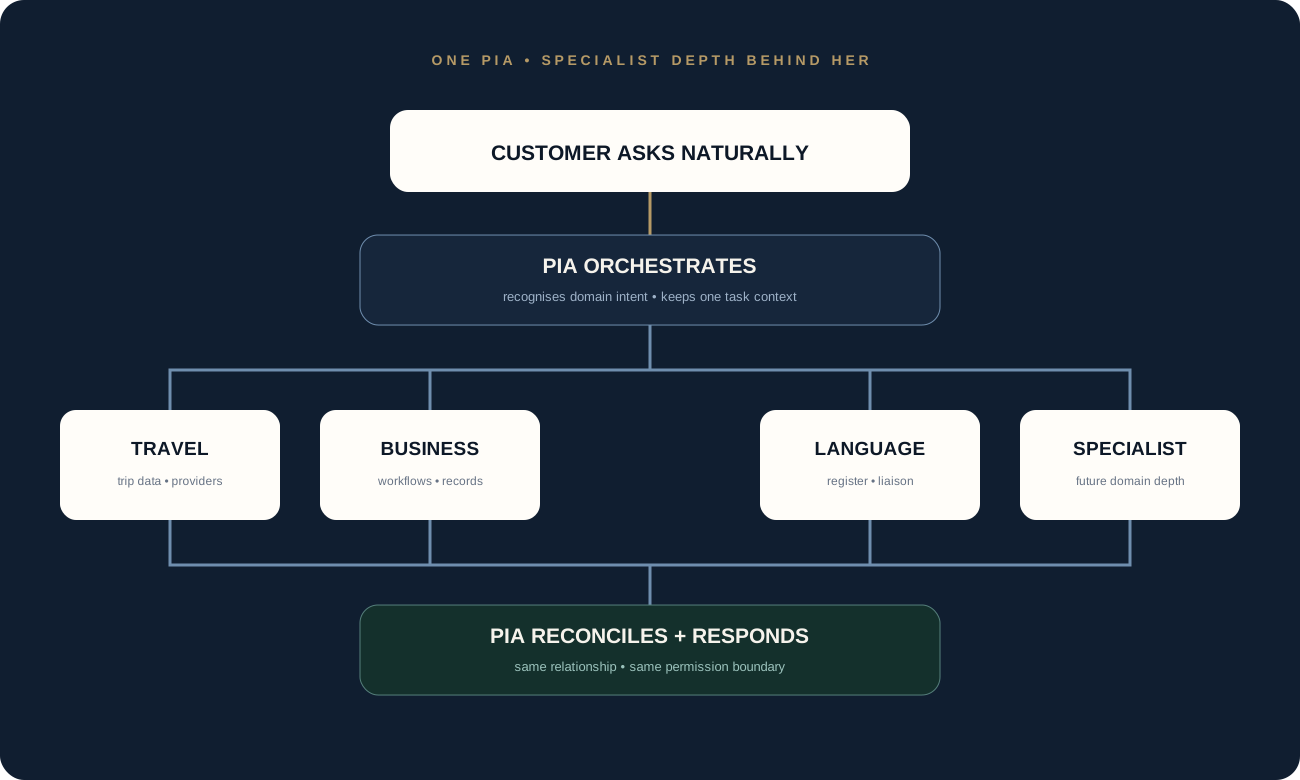
Travel, business, language and future specialist roles can contribute domain data, knowledge, workflows, tools and provider connections while Pia remains the speaker and relationship owner.
Routing to a specialist may increase depth. It must not increase permissions, spending authority, safety authority or account authority.
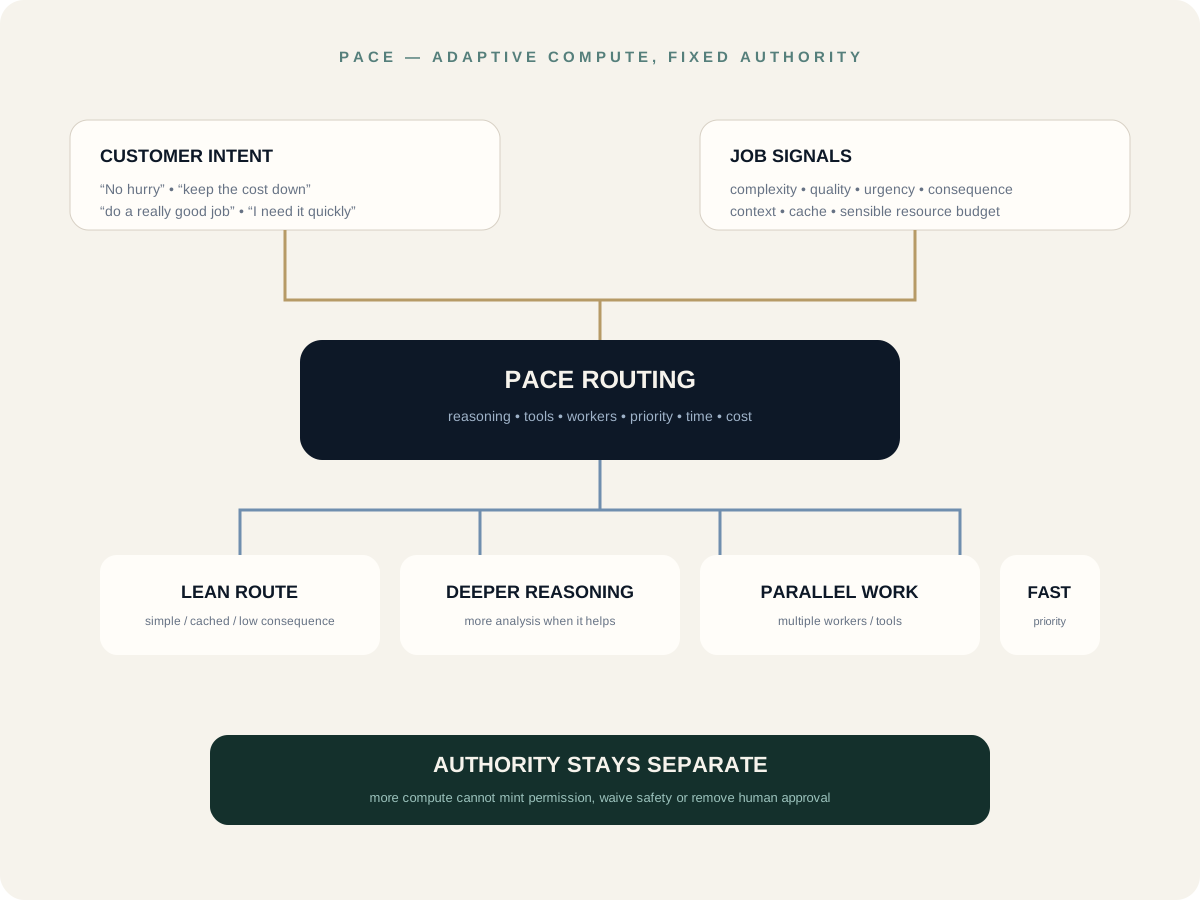
Ordinary AI systems often ask, “Which model should answer?” PACE asks a broader question: what combination of reasoning, tools, context, workers, priority and time is appropriate for this job?
Complexity, importance, error consequence, quality, urgency, available context and sensible resource expenditure can all matter. The customer should be able to say things like “no hurry”, “keep the cost down”, “do a really good job” or “I need this quickly”.
PACE may change resource choice, reasoning depth, parallel work, time and cost. It does not silently change permission, safety classification or human approval requirements.
Adaptive-compute architecture is canonical; current production evidence supports foundations and telemetry rather than a blanket claim that every PACE route is fully deployed.
The evidence architecture distinguishes sourced fact, inference, estimate, conflict, unknowns and stale/current information. Higher-rigour questions can route into Ask the Boffins rather than forcing every everyday interaction into maximum research mode.
The machinery stays mostly behind the scenes. The trust does not.
External models and services can still be useful. The design goal is selective connection: the durable customer relationship remains under PIA-controlled architecture while an external service receives only what is reasonably necessary for the authorised task.
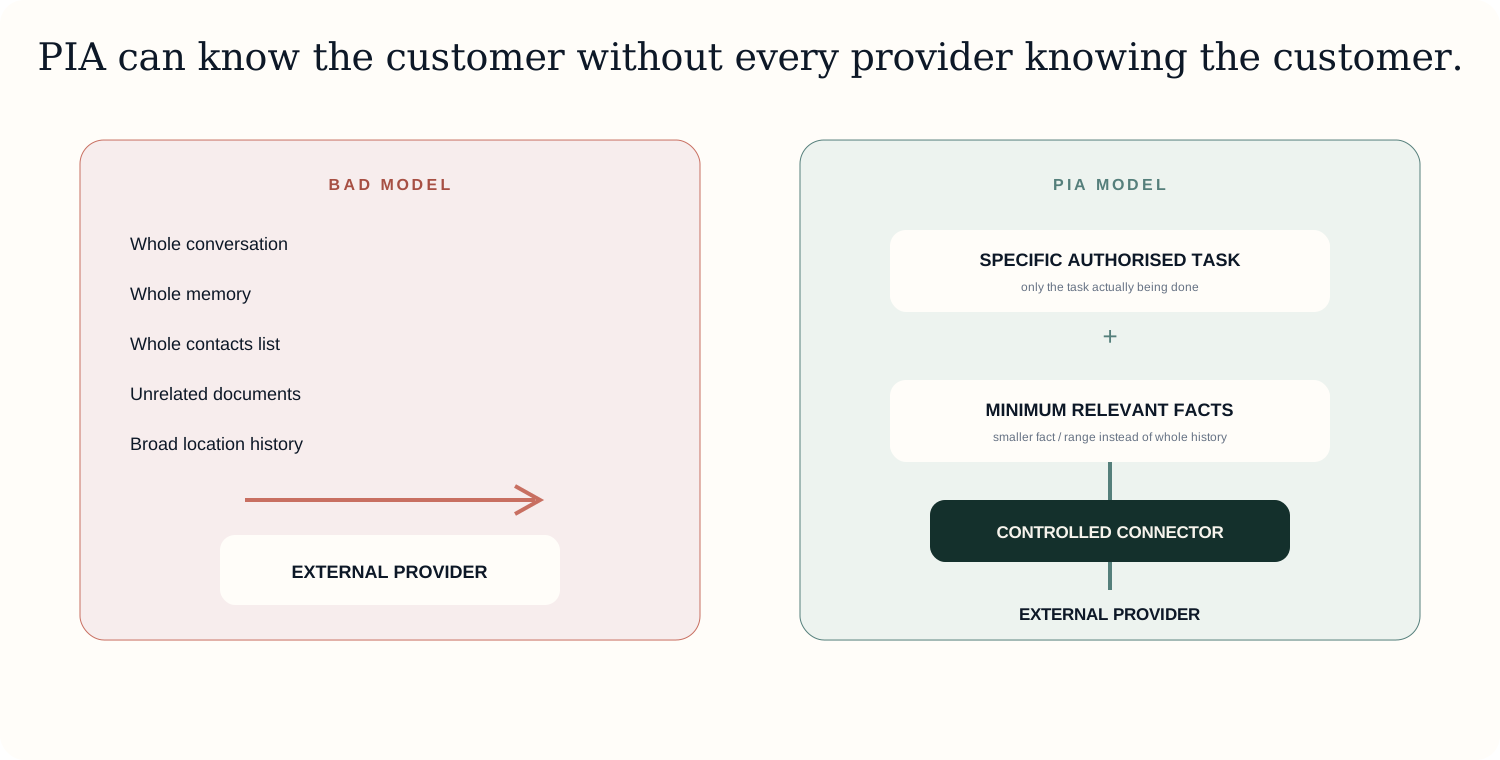
PIA Office's engineering baseline uses actual information boundaries: tenant ownership, server-controlled roles, Row Level Security where applicable, and separate retrieval/policy paths for different data classes.
This is a public-safe description of the control model, not an internal schema or security configuration.
Technical access, permission, exact action authorisation and proof are separate questions. A connected account is not blanket authority.
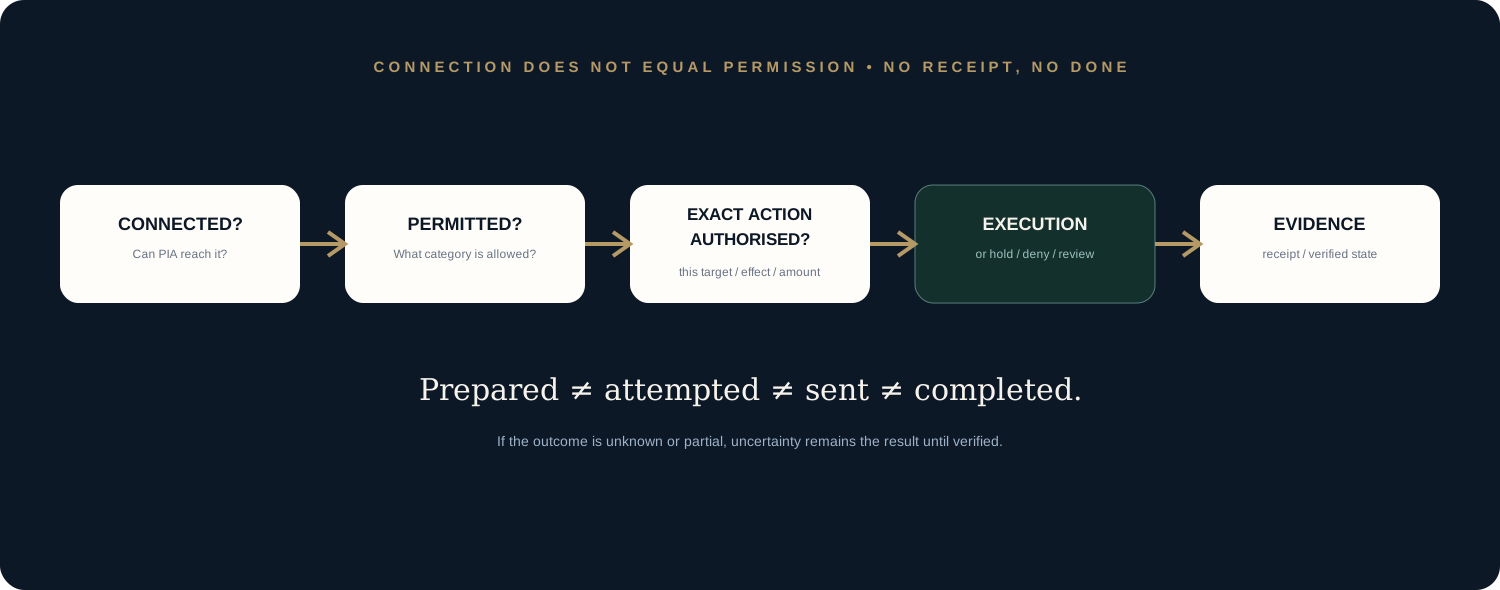
Reading and drafting can be treated differently from publication, deletion, security changes, payment, binding terms or irreversible action. The higher the consequence, the stronger the authority and evidence requirement.
Prepared, attempted, submitted/sent, confirmed/completed and unknown/partial are not interchangeable. A provider acknowledgement does not automatically prove the real-world outcome.
If the system cannot prove whether an action completed, it should preserve that uncertainty rather than guess success or blindly repeat the action. Where retry could duplicate a message, booking, order, payment, deletion or other consequence, provider state should be reconciled first.
Authority applies to the action actually approved. A material change to recipient, account, amount, currency, price, target, scope, timing, risk or irreversible effect requires the authority decision to be reconsidered.
These functions solve different problems and are intentionally separated.
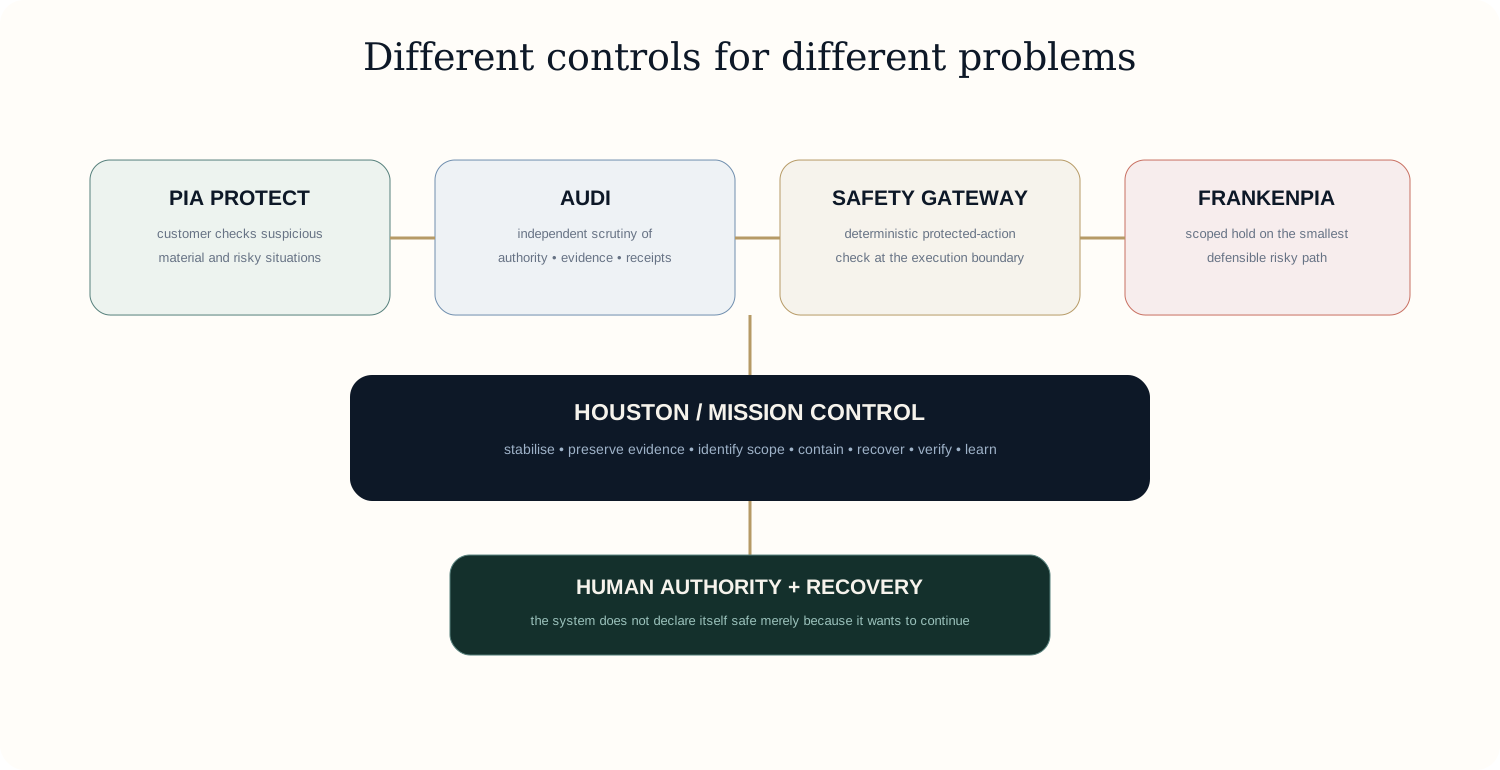
Customer-facing help for suspicious messages, links, invoices, unusual requests, social engineering, risky decisions and recovery. It is assistance, not perfect scam detection.
AUDI examines authority, evidence, contradictions, receipts and control integrity. AUDI is not the daily worker and should not simply execute the action being reviewed.
Protected actions are intended to pass an authority/policy gate outside ordinary conversational generation before execution or hold.
A scoped protected-action hold can stop one risky route while safe chat, explanation, read-only research and planning continue.
Stabilise, preserve evidence, identify scope, contain, recover, verify and learn. The customer remains a primary human authority.
The system doing the work should not be the only system deciding whether the work was authorised, completed and safe to release.
Surface personality preferences can remain user-configurable while protected governance, operational permissions, oversight and recovery are kept separately governed.
American AI's higher-level human-governance principles are adopted. The later Open Conscience / character programme remains research and should not be presented as a completed security technology.
Open Conscience technical details remain working research. Human stop, oversight and recovery remain part of the protected architecture rather than being delegated to the character itself.
PIA separates document approval from capability approval. The Capability Registry and Claims Registry architecture maps public wording to current evidence, dependencies and limitations.
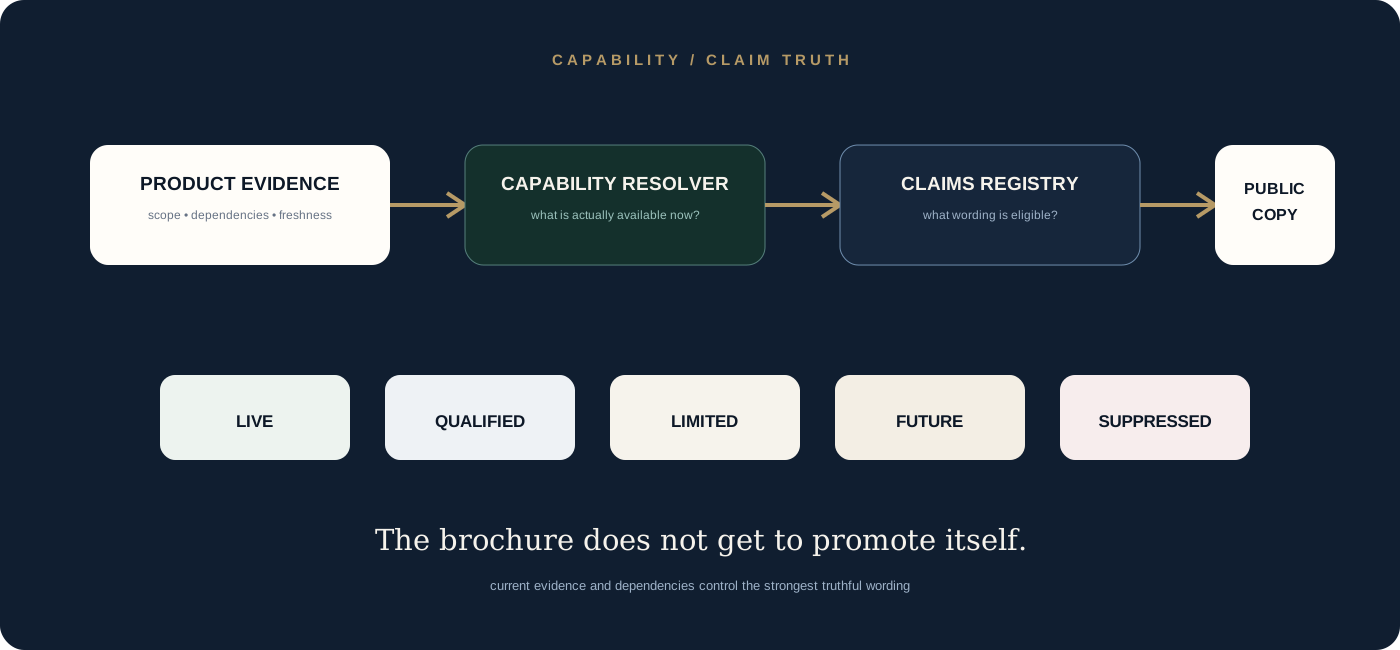
A brochure is not proof. A mock-up is not proof. Code existing is not automatically proof of customer availability.
The architecture is not supported only by design documents. A current static inspection of the private reference snapshot, observed 8 October 2026, confirms concrete source structures for shared Pia personality, state/human-presence foundations, Guardian/protection behaviour, typed actions, delegation, capability discovery, integration metadata and server-side connected-action foundations.
Static inspection shows that these structures and metadata exist in source at the dated snapshot. It does not prove that all 26 actions are publicly available, production-integrated, correctly configured, secure at runtime or reachable by every customer. Conditional and planned actions are not presented as live.
The site does not collapse implementation evidence, owner-approved architecture and future research into one claim.
Current records show substantial implemented platform foundations. Exact feature availability remains release-specific.
Canonical or owner-approved architecture with varying implementation depth; not every layer is one fully deployed universal runtime.
Strategically important directions kept clearly separate from current production claims.
A control that cannot be tested is difficult to trust. PIA's separations are intended to support executable tests that try to break the boundary, not merely demonstrate a happy-path conversation.
Can hostile instructions in email, webpages, files or tool output widen action or disclosure scope?
Can a model, worker or integration execute an effect without the required effective authority?
Can one synthetic customer retrieve another customer's restricted data?
Can an expired session, revoked permission or stale worker still act?
If recipient, amount, target or other material conditions change, is prior authority narrowed or invalidated?
Can an external task cause unrelated secrets or customer context to leave the intended boundary?
Does a lost provider response become UNKNOWN/PARTIAL rather than optimistic success?
Does the system reconcile provider state before repeating a potentially consequential effect?
Does explicit correction or forgetting stop stale information from being used across relevant state?
If a capability, provider or evidence record becomes stale, does public wording qualify or suppress accordingly?
The academic evaluation programme proposes future use of adversarial-agent and stateful tool-use benchmark families such as AgentDojo, ASB, ToolSandbox and τ-bench, alongside PIA-specific tests. The measures should include unauthorised effects, leakage, duplicate actions, evidence correctness, recovery correctness and utility—not text quality alone.
The same relationship architecture can extend beyond a browser. Device capability should never create authority.
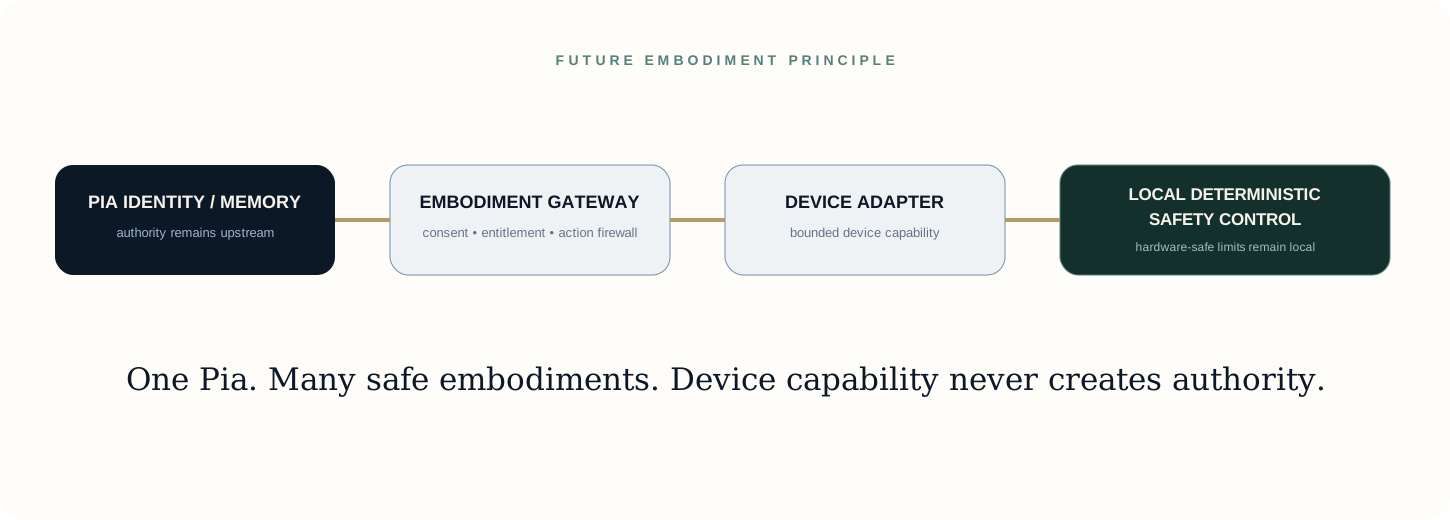
Future architecture only. A vehicle stack remains responsible for driving safety; a language model is not presented as improvising raw safety-critical control.
Public technical transparency can describe what the layers do, how authority is separated, why minimum context matters, how receipts work and where humans remain in control.
Credentials, secret locations, privileged routes, unpublished thresholds, exploit logic, containment triggers, adversarial tests and sensitive internal prompt material remain controlled.
These are contextual references, not certification, endorsement, partnership or a claim of formal compliance.
Resource-centric access, explicit authentication/authorisation and no implicit trust merely because something is connected.
NIST SP 800-207 →Prompt injection, sensitive-information disclosure and excessive agency reinforce the case for narrow tools and controls outside model prose.
OWASP GenAI →Lifecycle risk management, evaluation, traceability and governance provide useful public comparison points for generative-AI systems.
NIST AI RMF →A management-system approach to AI accountability, transparency, risk treatment and continual improvement.
ISO overview →