Personal footprint intelligence
Personal emissions estimates, explanations, practical reduction guidance and clear separation between gross emissions, reductions and any later external instrument.

American AI's environmental estate combines developed climate-domain knowledge, personal and business emissions workflows, practical reduction systems, controlled methodology, evidence records and established carbon-market infrastructure.
Measurement, operational reduction and evidence sit upstream. Residual-carbon action comes later, and remains separate from the underlying inventory and from any independent assurance or carbon-neutral claim.
PIA, PIA Office, Fumi and specialist travel applications can draw on the same environmental foundation without turning climate into another product tile.
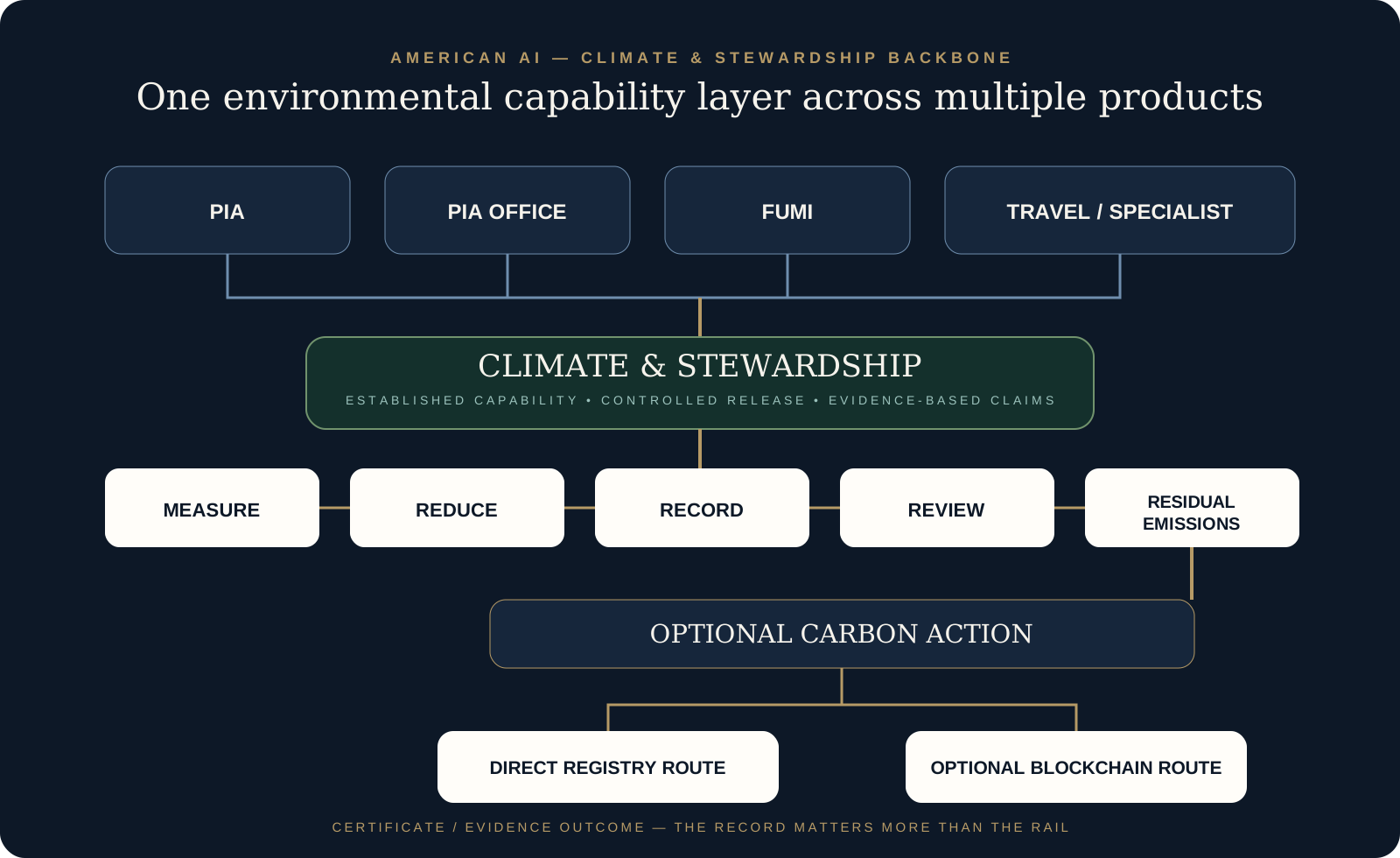
Blockchain when useful. Simple registry action when better. Evidence either way.
Founder-developed climate work expanded through emissions programmes, carbon accounting, registry-linked environmental units, certificates, transaction systems and programmable-value engineering. Those capabilities now sit alongside personal AI, business systems, trust architecture and travel.
American AI's environmental estate draws on that substantial climate, software and programmable-value work. The company maintains distinct technical, registry, corporate and evidence records so that each environmental action and claim can be traced accurately.
Supporting chain-of-title, registry and corporate records are maintained as part of the diligence estate.
Personal emissions estimates, explanations, practical reduction guidance and clear separation between gross emissions, reductions and any later external instrument.
Organisational boundaries, Scope 1, Scope 2 and relevant Scope 3 activity data, controlled factors, documented assumptions and an auditable record.
Energy, equipment, transport, waste, water and other practical reduction work with owners, milestones, evidence and comparable periods.
Carbon Credit Coin added registry-linked carbon, minting and project-reference records, wallet and transaction engineering, burn/retirement infrastructure and certificate capability. Blockchain is available where it adds value; conventional registry action can be used when it is the simpler route.
The CCC environmental convention is 1 CCC = 1 kg CO₂e and 1,000 CCC = 1 tonne CO₂e. The current reference denomination is US$0.01 per CCC.
The ordinary customer should care most about what happened, which units were used or retired, and what the resulting record or certificate establishes.
American AI's customer-credit strategy uses a US-cent denomination for eligible service value. The long-term shared-credit architecture is intended to allow value to be retained or used across eligible American AI services and, where offered, applied toward optional climate action.
Service credits and carbon units remain distinct records and should not be described as legally identical assets merely because they share an intuitive economic denomination.
Carbon measurement, reporting, pricing and accountability are becoming more relevant to ordinary business operations, trade, transport, procurement and market access.
covered by direct carbon pricing through 87 implemented policies in 2026.
mobilised by carbon pricing in 2025.
covering about 26% of global GHG emissions across jurisdictions representing 63% of global GDP.
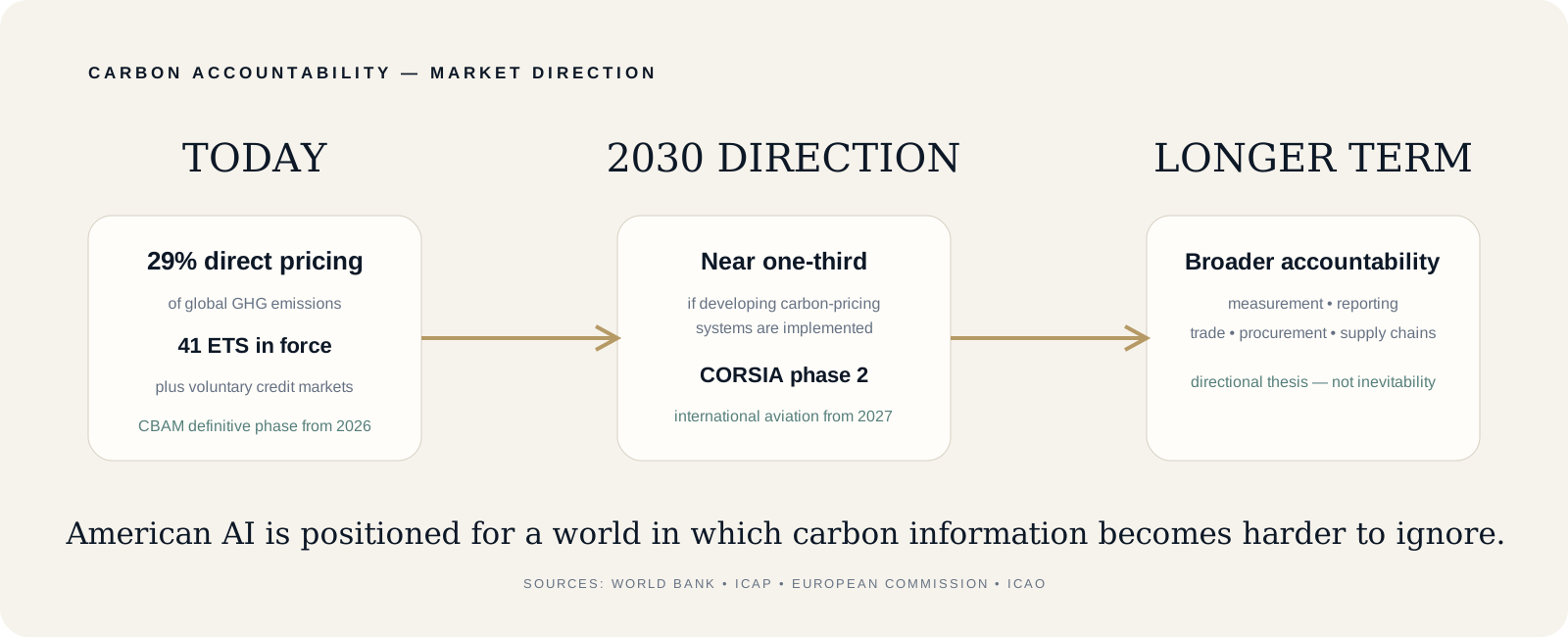
The definitive EU Carbon Border Adjustment Mechanism regime applies from 1 January 2026 for covered goods, making embedded carbon relevant to import economics and market access.
International aviation moves into CORSIA's second phase from 2027, with ICAO listing 134 participating States for 2027.
ICAP reports new national-level emissions-trading systems launching in Japan, India and Vietnam in 2026, alongside established systems elsewhere.
World Bank — State and Trends of Carbon Pricing 2026 · ICAP — Status Report 2026 · European Commission — CBAM definitive regime · ICAO — CORSIA participation.
Government-mandated carbon pricing, emissions-trading schemes, border measures and other regulated requirements.
Credits may be used in voluntary and, where eligible, compliance contexts subject to the exact programme, methodology and integrity rules.
Individuals or businesses may choose to address residual emissions beyond a direct legal requirement.
American AI begins upstream: measure, reduce, record and preserve evidence whether the final driver is voluntary, regulatory, supply-chain, procurement or market access.
Measured change in the customer's own activity is distinct from buying an external credit.
Blockchain can provide transaction evidence; it does not by itself prove the environmental quality of the underlying unit.
A certificate records the defined environmental action and supporting evidence; it is not automatically independent carbon-neutral certification.
Independent assurance or certification remains separately scoped from PIA's workflow and evidence preparation.
Current release boundary: the environmental capability and supporting carbon infrastructure are established. Customer-facing availability remains product- and jurisdiction-specific. No page automatically confers independent certification, a carbon-neutral claim or regulatory status; those depend on the exact activity, evidence and applicable rules.